
Published . 7 minute read. By V&M Systems Group.
Key points
- AI roof damage detection is pattern recognition on roof imagery. A model trained on examples of damaged and undamaged roofs flags candidate damage, and a person reviews the flags.
- V&M RoofView captures each roof by drone from 200+ ft above ground level using 10 or more image angles, and a self-learning photo-comparison model checks flagged damage against prior captures of the same roof.
- For a claim, a pre-storm baseline capture and a post-storm capture of the same property show what changed. That is the question a claims file has to answer.
- Hail damage on asphalt shingles shows as granule loss, dents, surface cracks and tears. Wind performance depends on the sealant bond between shingles, according to testing by the Insurance Institute for Business & Home Safety (IBHS).
- Wind and hail made up 42.5% of homeowners insurance losses in 2023, and about one in 35 insured homes has a wind or hail claim each year, according to the Insurance Information Institute.
What is AI roof damage detection?
AI roof damage detection is software that examines imagery of a roof and marks the places that look like damage. It recognizes patterns it was trained on rather than measuring anything directly, so its output is a set of flags for a person to check.
The imagery comes from a drone. In V&M RoofView, V&M's roof-intelligence platform, pilots capture each roof from 200+ ft above ground level (AGL) using 10 or more image angles, so the model has more than one view of the roof.
Those captures are flown under 14 CFR 107.51, the Federal Aviation Administration rule that limits a small unmanned aircraft to 400 feet above ground level unless it stays within a 400-foot radius of a structure and no more than 400 feet above the top of that structure. The pilots are FAA Part 107 certified: they hold the remote pilot certificate with a small UAS rating that 14 CFR 107.12 requires.
A second model does photo comparison. It is self-learning, and it verifies flagged damage against prior captures of the same roof. Detection answers whether an area looks like damage. Comparison answers whether it was present in the last capture. Both run in V&M's own pipeline, which processes 500+ GB a day. V&M built and owns the models and the pipeline. It is not a reseller.
How do hail and wind damage show up on a roof?
Hail damage on asphalt shingles shows as granule loss, dents, surface cracks and tears, up to a fully compromised shingle. Wind damage starts at the sealant bond between shingles. Those are the patterns a detection model learns and a reviewer checks.
The Insurance Institute for Business & Home Safety (IBHS) rates shingles on those damage types in laboratory tests that replicate realistic hail impacts. Its leakage study found that leakage rises with dent size, with small dents producing negligible leakage, and with tear severity. A reviewer therefore cares about the size of a hit, not only the count.
Hail does not have to be large. The National Weather Service classes a thunderstorm as severe when it produces hail 1 inch in diameter or larger or winds of 58 mph or greater, and the NWS Melbourne, Florida forecast office notes that storms producing hailstones the size of quarters (about 1 inch) or larger can damage roofs. IBHS testing of hail under 1 inch, which it calls sub-severe, found that it knocks protective granules off asphalt shingles and that naturally weathered shingles hit by two simulated sub-severe events were up to ten times more susceptible to damage from later large hail than new shingles. A roof can carry real damage from hail that never met the severe threshold.
Wind works differently. Self-sealing asphalt shingles rely on a temperature-activated adhesive strip applied during manufacturing. IBHS wind testing found the strength of that seal to be the most important factor in high-wind performance, and its durability work found sealant strength critical to resisting wind damage, particularly after hail impact. A hailstorm can set a roof up for the next windstorm, and IBHS describes damage to roof coverings as one of the main drivers of insurance losses.
| Damage | What it looks like on the shingle | Why it matters for a claim |
|---|---|---|
| Hail, 1 inch and larger | Granule loss, dents, surface cracks, tears; a fully compromised shingle in the worst case | Leakage rises with dent size and tear severity (IBHS) |
| Hail under 1 inch | Granule loss | Weathered shingles hit repeatedly are more susceptible to later large hail (IBHS) |
| Wind | Failure of the sealant bond between shingles | Seal strength governs high-wind performance, particularly after hail impact (IBHS) |
Why does a pre-storm baseline matter for a claim?
A pre-storm baseline answers the one question every hail or wind claim turns on: whether the damage was there before the storm. V&M flies a baseline capture of the roof before the storm and a post-storm capture of the same property afterward, and the photo-comparison model verifies flagged damage against the earlier imagery.
Without a baseline, the adjuster works from the post-storm roof alone. The Insurance Information Institute says "An adjuster is a person professionally trained to assess the damage," and it tells policyholders to contact their agent or company immediately and to consider photographing or videotaping the damage. A dated aerial capture from before the storm adds the other half of the record: the roof as it was before anyone had a reason to dispute it.
The volume makes this worth doing. Wind and hail accounted for 42.5% of homeowners insurance losses in 2023 and were the largest cause of loss in every year from 2019 to 2023. Over that period, wind and hail claims ran at 2.80 per 100 house-years (one house-year is one home insured for 12 months), with an average of $14,747 paid per claim. About one in 35 insured homes has a wind or hail property claim each year. The Insurance Information Institute, citing NOAA's Storm Prediction Center, counts 5,432 major hail events in 2025, meaning hailstones 1 inch in diameter or larger, with Texas (902) and Kansas (375) recording the most.
What is in a drone roof report?
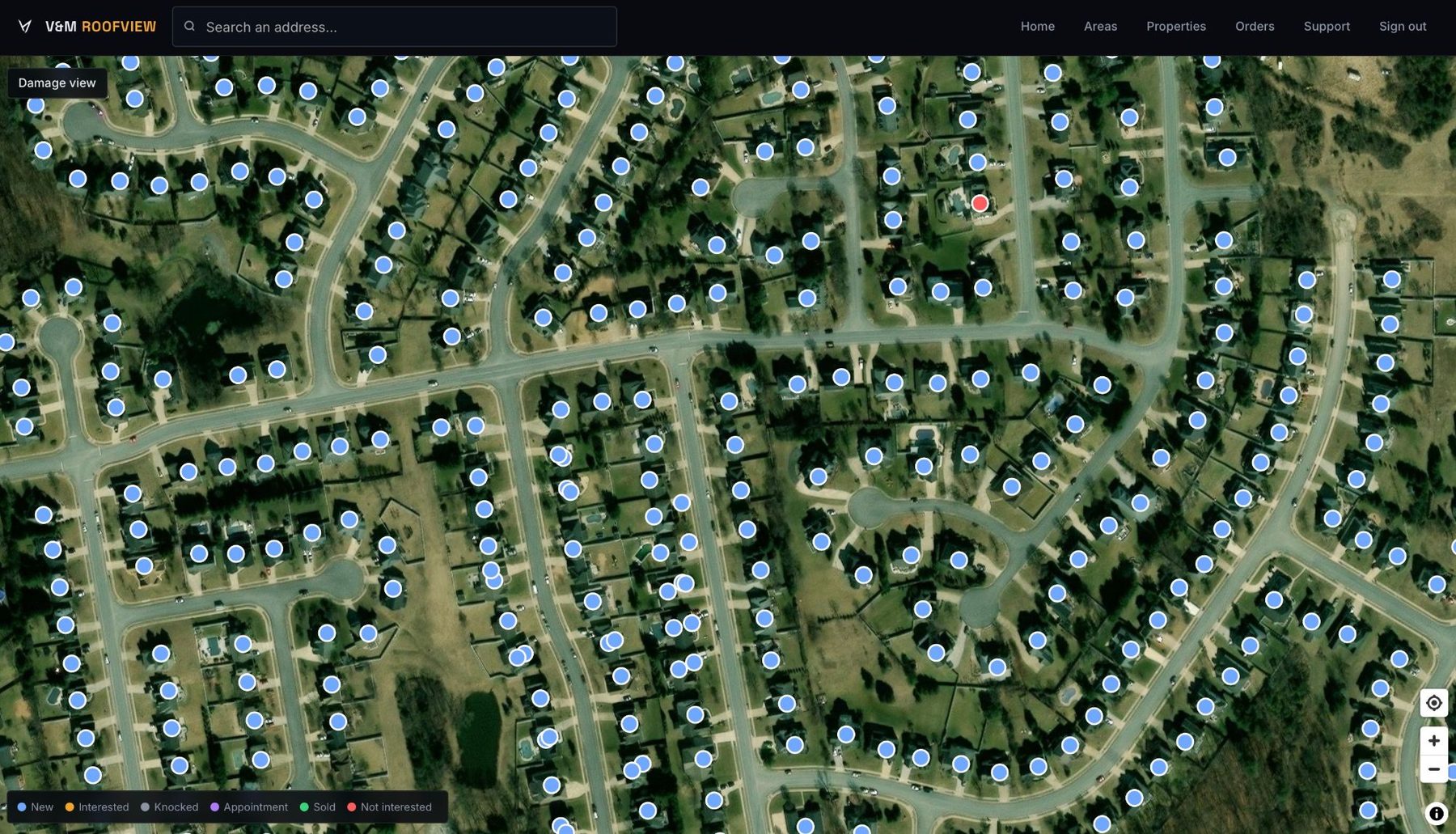
A drone roof report in RoofView is a PDF for one street address, backed by the imagery, measurements and flags for that roof inside the platform. A signed-in client sees:
- Structures indexed by street address.
- Potential damage flagged.
- A deep-zoom viewer at capture resolution.
- Tap-to-measure roof area with pitch selection.
- A map view.
- A PDF report for each address.
The RoofView service page also shows a screen from the platform's hail detection viewer, which marks candidate hits on a straight-down photo, at about 1.2 mm per pixel in that sample. The pre-scan is a candidate list, not a verdict. A reviewer confirms or dismisses each mark.
Client accounts are issued by V&M per company, and each client sees only its own data. Imagery is loaded into the account the same week as capture. The pipeline behind the report is described on the Data Processing page.
| Report item | Use in a claims file | Use in a roofing estimate |
|---|---|---|
| Flagged imagery | Locates the candidate damage the adjuster inspects | Decides whether a truck roll is justified |
| Pre-storm and post-storm capture | Shows what changed on the same roof | Backs the homeowner's claim with dated imagery |
| Roof area with pitch | Checks the roof area on the estimate | Prices the job before anyone climbs |
| Per-address PDF | Drops into the claim packet | Drops into the customer file |
How do roofing contractors use aerial imagery for lead generation?
Roofing contractors use the flagged imagery as targeting data. A neighborhood is captured after a storm, the roofs showing potential damage are flagged in the list and on the map, and the sales team works that list instead of knocking every door.
V&M has run a recurring rooftop imagery program on the East Coast since 2025. Five contractor clients reorder regularly, some several times a month, and clients report sales close rates up more than 180% from the targeting data in the reports. Capture cost is about $5 per house, or as low as $3 per house at large scale. Pricing is by the job, and V&M confirms the price and the delivery date when it quotes. Mission planning covers captures of 1,500+ structures at a time.
The same report serves the estimate, since tap-to-measure returns roof area with pitch from the imagery. Where a client needs annotated findings on a commercial roof, a tower or a facility rather than a per-address report, that is V&M's separate aerial inspection service.
What AI roof damage detection does not do
AI roof damage detection does not replace the adjuster, and V&M publishes no detection accuracy figure. The model proposes candidates, and the claims decision stays with the carrier's adjuster.
RoofView imagery records the roof surface. It does not show the underlayment or the deck beneath the shingles, and it does not substitute for a hands-on inspection where one is required.
Flags are only as good as the capture behind them. The damage-detection model works from imagery captured at 200+ ft above ground level using 10 or more image angles.
Frequently asked questions
Can AI roof damage detection replace an insurance adjuster?
No. The model flags candidate damage. In RoofView's hail detection viewer, the pre-scan is a candidate list, not a verdict, and a reviewer confirms or dismisses each mark. The Insurance Information Institute describes an adjuster as a person professionally trained to assess the damage, and that assessment stays with the carrier. What the software changes is what the adjuster starts with: a dated, multi-angle capture of the roof, flagged, and compared with any earlier capture of the same property.
How high does the drone fly for a roof capture?
V&M captures roofs from 200+ ft above ground level using 10 or more image angles. Captures are flown under the 400-foot ceiling that 14 CFR 107.51 sets for small unmanned aircraft, by pilots who hold the FAA remote pilot certificate with a small UAS rating required by 14 CFR 107.12. In controlled or restricted airspace, V&M handles the waivers, authorizations and coordination.
What does a pre-storm baseline capture cost?
About $5 per house. At large scale the capture cost drops to as low as $3 per house. Pricing is by the job, and V&M confirms the price and the delivery date when it quotes. The baseline and the post-storm capture are of the same property, and the photo-comparison model verifies flagged damage against the earlier capture.
Does hail smaller than 1 inch damage a roof?
Yes, according to IBHS testing. Hail under 1 inch falls below the National Weather Service severe threshold, and IBHS calls it sub-severe. It knocks protective granules off asphalt shingles, and naturally weathered shingles hit by two simulated sub-severe events were up to ten times more susceptible to damage from later large hail than new shingles. A roof can carry damage from hail that never met the severe threshold.
How soon after capture is the imagery available?
Imagery is processed and loaded into the client's RoofView account the same week as capture. V&M's pipeline processes 500+ GB a day, and three full-time operators plus 21 vetted contract pilots across the United States, all FAA Part 107 certified, cover a territory without mobilization cost.
Who can see the imagery in RoofView?
Only the client it belongs to. V&M issues accounts per company, and each client sees only its own data. Enabled accounts can download every original photo from a capture as a single archive with a manifest for their own records. New clients use the Set up an account button on the sign-in screen to request a call or schedule a 30-minute demo over Zoom.
Sources
- 14 CFR 107.51, Operating limitations for small unmanned aircraft, U.S. Government Publishing Office (govinfo.gov)
- 14 CFR 107.12, Requirement for a remote pilot certificate with a small UAS rating, U.S. Government Publishing Office (govinfo.gov)
- SPC Products (severe thunderstorm definition), NOAA Storm Prediction Center
- Hail Safety Rules, National Weather Service, Melbourne, Florida
- Hail Impact-Resistant Shingle Ratings, Insurance Institute for Business & Home Safety
- Water Leakage Vulnerabilities for Shingles with Hail Damage, Insurance Institute for Business & Home Safety
- Impact Testing of High Concentrations of Small Hail, Insurance Institute for Business & Home Safety
- Asphalt Shingle Durability, Insurance Institute for Business & Home Safety
- Wind Uplift of Asphalt Shingles, Insurance Institute for Business & Home Safety
- Facts + Statistics: Hail, Insurance Information Institute
- Facts + Statistics: Homeowners and renters insurance, Insurance Information Institute
- Settling insurance claims after a disaster, Insurance Information Institute
About V&M Systems Group
V&M Systems Group LLC is a Virginia small business headquartered in Edinburg, Virginia. It flies unmanned aircraft for inspection, mapping and imagery with FAA Part 107 certified pilots, leases Blue UAS-listed aircraft, builds and owns the V&M RoofView roof-intelligence platform, and, through V&M Advisory, provides energy and infrastructure advisory for U.S. government programs and companies in emerging markets. SAM active, CAGE 25KG5, UEI K51PB7ZFL4K6.